The France trip
8/31/12–9/8/12
What it costs
Airfare
Airfare from Knoxville to Paris was about $1,200. It took
only 8 hours to get from Atlanta to Paris, and when we arrived in was the
morning of the next day (6 hours ahead of Eastern Standard Time).
Taxi
It cost about 55 euros (exchange was $1.30 per euro when we
traveled) to take a taxi from the Charles de Gaulle Airport to our Paris hotel—it
cost our friends more like 65 euros--who knows why. Taking a taxi is fairly
pricey—much better to use the metro. If you take a taxi at night, the price
goes up by 50%--not sure at what time the price changes. I think it also goes
up if you take a taxi before 8 a.m. If you have four people in the taxi add
another 3 or 4 euros; if you have a lot of luggage add a few more. Drivers don’t really expect a tip.
The Metro
The metro costs 1.70 euros per trip. The Paris metro works
basically like all metros: make sure you know which line you want, and make
sure you know the end stop on that line—that way you end up traveling in the
right direction instead of the wrong direction on the correct line.
Museums
Most museums cost 9 or 10 euros each, but are free on the
first Sunday of every month—which, unbelievably, was the very day we headed to
the museums!
Laundry
If you get your laundry done by your hotel it will cost you
about 6 euros for one shirt; that’s 7 or 8 bucks. It’s a dollar or two less if
you can find a laundry service. My advice, take enough clothes so you don’t
need to launder anything.
Luggage
Take only one wheeled suitcase per person—either checked bag
or carry-on; take a backpack for your other carry-on, and a purse. That way if
you find yourself needing to take the Metro with suitcases in tow, you won’t be
completely obnoxious and awkward--or if you find yourself with time to kill
before your flight, but have already checked out of your hotel. Our friends
took only wheeled carry-ons and seemed to do okay. I was glad I’d checked a
larger (not much larger) bag so that I had enough clothing to make it through the
week.
Hotels
I think our hotel cost about $110 per night, which was a
pretty good deal. It was recommended by a colleague of Russel’s who speaks
French and has been to France many times. This hotel was near the Latin
Quarter—which we discovered quite by happy accident—and also by the ruins of a
Roman arena, hence the name of the hotel: Des Arenes. Now, kids play soccer in
the arena and old men use it to play a version of bocce ball.
On a boat trip down the River Seine—I think about 12 euros (the
price was bundled into our bike tour—so I’m not positive), some other Americans
were telling us how they got their hotel on Priceline.com. They put into
Priceline that they wanted a $100-a-night, three-star hotel near the Eiffel
Tower. Well they got a 4-star hotel for a terrific deal right near the Tower. I
can’t remember the exact price they paid, but it was a great deal. Typically
hotel rooms are very small—just enough room for small beds—not queen-size;
bathrooms are tiled from top to bottom including the floor of course—same in
Spain. All the toilets have a different variety of flusher, although the most
common is some form of a push circle in the top of the tank lid. Strangely
enough, many toilets do not have seats on the bowls. Frequently you have to pay
about .50 euros to use a bathroom, and once when I paid 1.50 euros there still
wasn’t a toilet seat on the bowl! Strange indeed. We did ask our Parisian guide
at one point what was up with the lack of seats and she opined it was cleaner
that way. Hmm. The toilets in the hotel rooms did have seats. (I suppose one could
bring one’s own, but it would be rather awkward to carry around.) Even the wash basins were challenging. If you
can’t figure out how to turn on the water, look for a button on the floor, or a
little rod under the bowl
Bottled water
Bottled water at a restaurant, or a soft drink for that
matter, costs around $5.
Sitting down at a sidewalk café
If you are tired and want to sit down at a quaint sidewalk
café, make sure you order off the sit-down menu. If you order standing up at
the “take away” line, they won’t let you sit—the menu to sit is several euros
more expensive per item. Well ok, if you
order standing up, you may be able to go sit for a few seconds before they come
blustering out to upbraid you and demand that you a) pay the sit-down price for
the food you’ve just bought from them, b) stuff that food into your purse and
now order some real sit-down food, or c) slink away in shame and never again
darken their doorway.
Train ride to Nancy
$130 each round trip, non refundable, non changeable. Very
comfortable ride and very fast.
Fashion
All the fashion windows were filled with black & white
and neutral-colored clothes with red accents. Occasionally there was a
different accent color—orange, maybe green—but red is definitively the accent color
du jour. I predict red polka dots
will be hot hot hot. (Yves St Laurent had a window on the Champs-Élysées featuring an old
wrinkly Asian woman dressed in a red dress with white polka dots—obviously that
will be big!)
What to wear in Paris:
So before we left for Paris, someone told us the French wear
mostly neutrals—a lot of black and gray, etc.—so if we didn’t want to stand out
we might want to take that into our wardrobe considerations. Since Russel and I
would have a hard time not standing out in any scenario, we decided to take the
advice to heart: I took two pair of black pants and two pair of neutral
brown/tan. Then every time I saw an obviously U.S. couple or family wearing
black, I knew they had “gotten the memo.” But it is basically true; Parisians are
not into the Hawaiian shirt look. So keep that in mind if you are planning any
trips to France and don’t want to look like a clueless U.S. tourist.
The French Language
If you don’t already know some French, do NOT bother
downloading beginning French lessons onto your iPod to listen to on the plane
trip over. Believe me, it will do you no good. French pronunciation is a
totally mind-blowing enterprise. By the time I got to beginning lesson three on
my iPod, my mind had turned to ribbons; I could hardly remember how to say bon jour, merci, and oui! I think I
did manage to say “Je ma pell Rebecca”
one time when we were in Paris! Once when we were riding the metro I looked at
the names of the metro stops on the charts inside the train and then listened closely
to the announcer say the name of the stop as the train arrived at that station;
that was how I came to understand the secrets of French pronunciation. Basically, the French take a running leap at
the first letter of a word, detour slightly, and then choke off the remaining letters
with a few moans and guttural sounds. On a bright note, those who actually can speak
French sound incredibly sexy, cosmopolitan, and smart. No wonder the French
don’t want to bother with English.

French Food
Well I can’t say I was much impressed with the food. This is
probably because I had no idea what I was ordering and ended up with strange
stuff, like sort-of-raw ham and bacon salad; Russel ended up with raw salmon,
and our friend ended up with nearly raw steak even though he asked for medium-well
and sent it back twice—wince. At the conference buffet, it was still hard to
find something yummy—a variety of very strange paté stuff. Yuck. But--as in
BUT--the pastry and bread were to die for. So my advice is to forget the
restaurants and just hop around to the pastry and sandwich shops. We did
however have some truly delicious quiche—we were, after all, in the province of
Lorraine.
Water: Make sure you order a caraf of water (carafe d’ eau) because otherwise you
will pay $5 or $6 for a small bottle of water.
We broke all the rules one day and ate in a perfectly
touristy restaurant when we were too tired to find an off-the-beaten-track
eatery. We ate in a little café right by the metro station that comes out on
the famous Avenue des Champs-Élysées.
Well we did pay $5 for the water, but we split a thin-crust pizza that was
fabulous. My advice, hit more touristy restaurants. Maybe they know what
Americans like!

Day Tripping to the Alsace
region
So while Russel was busy going to his academic conference sessions,
I went with other spouses on an all-day trip to the Alsace region of France—up
by the Eastern border with Germany. Turns out this region has changed hands
between Germany and France four times in the last 75 years, and before that is
was it was part of the Roman Empire ‘till about the 17th Century and
then part of Germany—hence the little villages of Kaysersberg, where Albert Schweitzer was born, and Riquewihr (rich village) looked Swiss or
German, rather than French. So here we are up in this small German-looking town
having lunch at a very German-looking-and-feeling restaurant, the scent of
sauerkraut is wafting through the air. None of the servers or the hostess speak
any English, the menu is in French and German, and we feel like we have really
entered foreign territory. As we munched on our foreign-looking food, wafting
over the radio, (along with the heavy scent of sauerkraut) came “Hey, I just
met you, And this is crazy, But here's my number, So call me, maybe?” (It is
true that these villages are preserved tourist towns, but still, you basically
feel like you are in a German village from a couple centuries ago, so Call me maybe was a bit jarring.)
Everyone told us that servers don’t really expect a tip; one
person told us they find it offensive, another told us to “round up.” So round
up we did.
Sights to see
Well in Paris every street is a picture postcard, really. Palaces,
armories, academies, gilded gates and statues, rivers, bridges, golden lamps,
intricate ironwork—everything you see is pretty much beautiful. So take an
extra battery for your camera along with your charger. (You do need an adapter.
Although at our first hotel, when the outlet in our room wasn’t working, we
took it downstairs to the desk clerk who plugged it directly into a three-prong
European outlet (three in a row—not the third round grounding slot like in a
U.S. outlet) using the two holes on the left, and it charged fine. But mostly
we used our adapter.
Flea Market
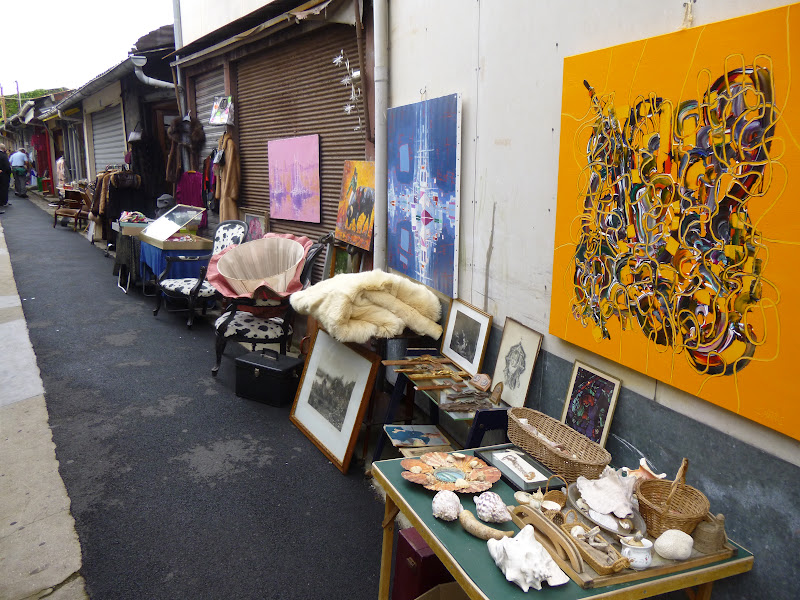
I was interested in going to the Paris Flea Market (Las Puces)
because the one in Madrid is so much fun. Well the Paris one isn’t quite so
much fun. Most of the time I thought they were selling cheap junk for 10 euros that you couldn’t sell at a
Knoxville garage sale for 25¢. The booths ranged from many clothing dealers,
antiques, pictures and books, super junk, and high-end art. It was either fleas or fleecing, with little
in between. Russel managed to make
friends with the dog of an art dealer who had spent time in San Francisco
working with design people there. I mean the art dealer had worked with the
design people. Russel also made friends with the art dealer, whom I thought was
quite handsome really. He (Olivier, the art
dealer) wore a purple shirt and spoke pretty good English. An amazing find,
because as you have no doubt heard, the French are not all that interested in
speaking English—unlike in Madrid where everyone wants to try out their English
on you. Anyway, I would skip the flea
market.

The Eiffel Tower
The Eiffel Tower, the icon of Paris, not much loved by the
Parisians—at least for a hundred years—was not on our “to see” list. I had seen it 30 years ago, and Russ and the
couple we went with didn’t have that much interest, but it turned out that the
bike tour we took departed from the south leg of the tower. So we did see it.
Not only that, but on our bike tour, the guides told us a number of very
interesting stories about it. Like the one about the guy who forked over
suitcases and suitcases full of cash to a scam artist because he thought he was
buying the tower. Or the fact that after Gustave Eiffel’s design was chosen for
the 1889 World’s Fair, he found out that he himself had to pay for most of the building
of it. He quickly redesigned the tower to include stairs and a lift and
recouped his money in very short order, charging people to go up the tower. After
20 years the tower was supposed to come down—but never did, obviously. And on
our night bike tour, as we came back at midnight, the tower began to sparkle!
Yes, apparently at night every hour on the hour the tower lights up with twinkle
lights. So it was pretty cool coming along at midnight and seeing the lights
twinkle on the tower. Plus there was a full moon showing just to the side of
the tower when we took our night ride on the river Seine. I’m not kidding.


Touring Paris by Bike
Riding bikes through Paris was super cool. It put me into a
very happy mood. In truth, I don’t have much of a travel bug, and I had felt
reluctant to go with Russ on this trip. But after biking in Paris, I started
looking into other cities that offer bike tours. The bike tour company is
called Fat Tire Bike Tours and they have offices in London, Barcelona, Berlin,
and Paris. Both our guides were from England.
After Russel and I had spent just a few hours in France, we were already
feeling frustrated at not being able to communicate with anyone and not knowing
what we were doing. It was very refreshing
to make contact with the tour guides who not only spoke English, but were more
than happy to explain things, tell you how things worked in Paris, and give
recommendations! Each tour was limited to 20 bikers plus the tour guide. We
rode as a group in the bus lane or taxi lanes through the streets of Paris.
Throughout the ride we would stop in front of this or that monument or statue
and our guides told us all sorts or interesting stories about Napoleón and the
monuments and Paris. For example, did you know that Napoleon the 3rd
visited London in the middle of the 19th century and found that it
was cleaner, and more modern, prettier, and easier to get around in than Paris,
so he commissioned Baron Haussmann to level 90% of Paris? Then he had it
rebuilt in the lovely neo-classical style you see today. (These guides were
from England, so who knows how much truth there is in the London visit. That
Paris was mostly leveled and that it is of a pretty much uniform neoclassical
style is quite true.) Also, did you know that Napoleon entered the military
academy at age 15 and graduated a four-year program in two years? And by age 21
was in charge of the army?
Anyway we enjoyed our four-hour bike tour so much that the
next day we signed up for the four-hour night tour (you get a discount). We
went to the Cathedral of Notre Dame, over to a famous ice cream store
(Berthillon) and got to-die-for ice cream (pear and deep chocolate flavors),
saw where Johnny Dep lives, and then biked across the Seine right through the
gates, just before they clanged heavily shut at 10 p.m. We pedaled around in back of the Louvre, then
coasted through the archway while a guy with a cello played, tooled around the Louvre
pyramid, and then off we went to the boat docks and a river cruise on the
Seine.


Before coming to France we’d thought about buying a two-day
bus tour pass that you can hop on and hop off as it goes around the famous
sights of Paris. I’m glad we did not end up doing that. One, it was pretty
expensive, $170; and 2) some of the museum entrance fees were included in the
price—but as I said, we got in free anyway; and 3), seeing Paris by bus? Not
cool.
Locking Hearts on the Bridge over the Seine
So there is this tradition (no doubt made up for tourists) of attaching a lock--that you buy on the bridge--onto the iron railings along the bridge over the Seine. You put your initials or names on the lock and then throw away the key. Sealing your love forever. The locks do look pretty, and there are thousands and thousands of them.
Museums
The art collections in Paris are so amazing that it would
really be a sin not to go to at least one museum. We planned on going to the Museum of Orsay, which has many of the
impressionists—Manet, Degas, Renoir, Monet, Gauguin, Cezanne, Van Gogh, etc.
etc. etc. The night before our planned visit, we heard the rumor that all the
museums are free on the first Sunday of the month. I thought that could never be
true, since that was the exact day we had planned to visit the Orsay. Well it
turned out to be true. So we saved about 9 euros each for admission to the
Orsay and about 10 euros each on the Louvre. We saw all sorts of amazing and
famous bronze statues and beautiful paintings. We both especially loved Van
Gogh—oh electric blue eyes and swirling universe—though really there were so
many great and famous paintings that you couldn’t take it all in and we kept
finding more and more “favorites.” We only stayed a few hours and then headed
to the Louvre, where we decided to take one of the two secret staircases our
bike tour guides had told us about that lead to the mall under the Louvre
area—yes, there are secret stairways and there is a mall with an Apple store
and two Starbucks and many other stores, and
an entrance to the Lourve. (We hear that the second Starbucks, after you go
through security but before you go into the museum, has free Wi-Fi). So while
throngs of people were hanging around waiting to get in the main entrance to
the Louvre up by the glass Pyramid, we whisked through security and got in
(free) in no time. The secret stairs are
located on either side of the Mini Arch d’ Triumph. We made the pilgrimage to
see the Mona Lisa, following the signs and pictures of Mona with directional
arrows (no other painting nor artist has this kind of helpful signage) up and
around past a gazillion amazing pieces of art work and a dozen no-picture-taking-allowed
signs, until we found ourselves in the room with Mona. Here we found at least
60 people crowded all around her taking pictures with their iPhones, laptops,
iPads, and super cameras. Totally amazing.
(Mona was flanked by two guards and a large piece of glass hung over the
picture area.) I got out my camera and took some shots of Mona and all the
people taking pictures. Then we spent time looking at the other lovely
paintings in the room that were all thinking to themselves, “And what are we?
Chopped liver?” We bought several Mona Lisa magnets as souvenirs—along with several
key-chain Eiffel towers in various bright colors—must buys—you have seen the
movie Sabrina with Harrison Ford?